
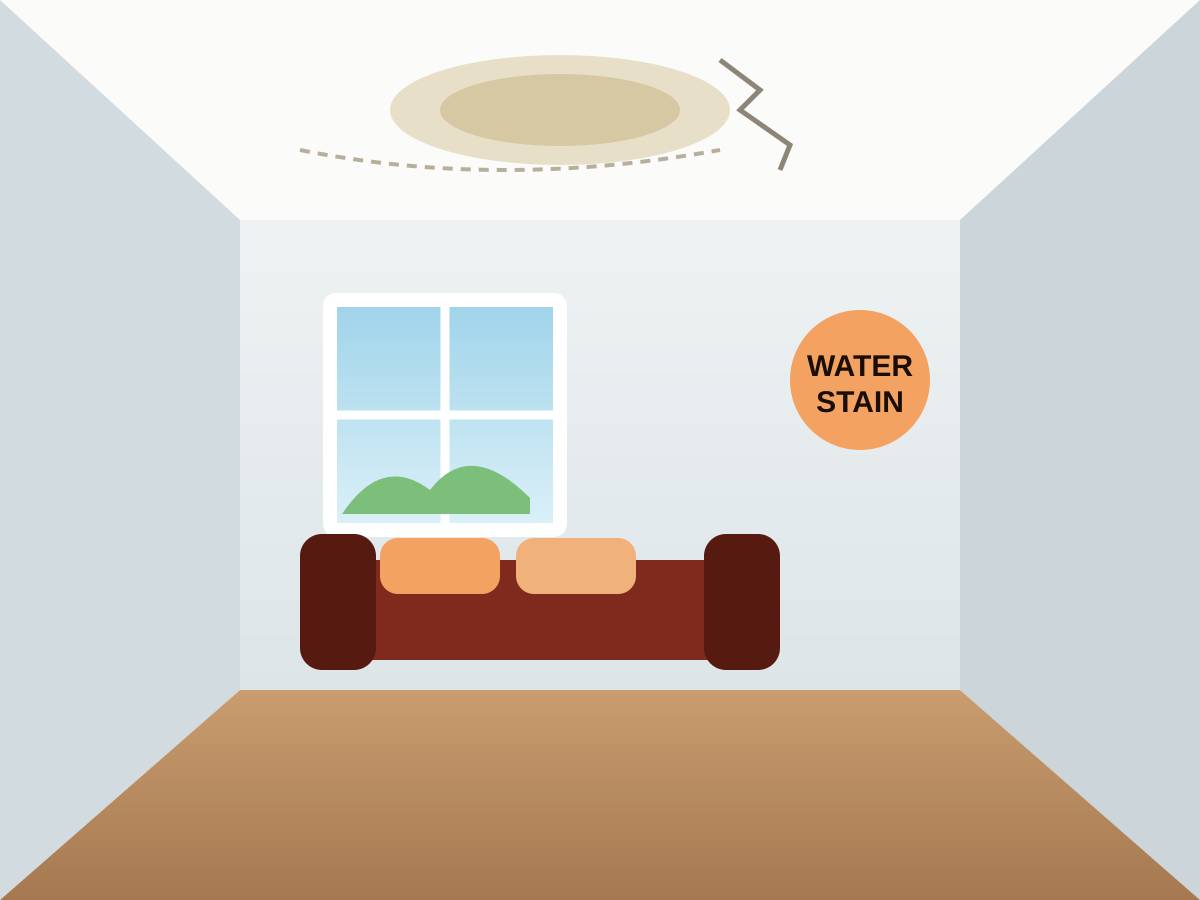
Where ceiling damage comes from in Homewood homes
A few causes account for most of the calls in this part of Jefferson County:
- Storm and roof leaks. Hail and wind-driven rain in spring and early summer find flashing around chimneys, skylights and dormers. The stain usually shows up weeks later.
- Attic air handlers. Many ranches and split-levels here have the HVAC unit in the attic. A clogged condensate line can drip onto the ceiling all summer before anyone notices.
- Bathrooms without good exhaust. Older baths often vent into the attic or not at all, and years of steam loosen texture and tape.
- Settling on sloped lots. Houses built into the hills between Red Mountain and Shades Mountain can shift a little over the decades, which shows up as seam cracks and nail pops.
- Plaster that has lost its grip. In the 1920s to 1940s houses of Hollywood and Edgewood, cracked or bowed plaster is often why popcorn was sprayed on in the first place.
What you'll see, and what it usually means
- A brown ring: water, past or present. The stain stays after the leak stops.
- Straight-line cracks: drywall joints where the tape has let go.
- Rows of small round bumps: nail pops, common in houses hung with nails before screws were standard.
- Spiderweb cracks or a bowed area: more typical of plaster that is separating from the wood lath above it.
- Texture flaking onto the furniture: usually moisture or age. Don't vacuum or scrape it until it has been tested (see below).
First steps when the damage is new
- Stop the source: roofer, plumber or HVAC tech first. No ceiling repair outlasts an active leak.
- Keep everyone out from under any soft, bulging or sagging area.
- Take photos before cleanup, for your records and any insurance claim.
- Leave popcorn texture alone until it has been checked, especially in a house built before the late 1980s. See testing a popcorn ceiling in Alabama.
- Let the area dry fully before anyone closes it up.
How the repair is usually done
For drywall, the pro cuts the damaged section back to sound material and framing, fastens in new board, re-secures any loose sheets around it, then tapes and finishes the joints over several coats. Water stains get a stain-blocking primer so they can't bleed through the new paint.
For plaster, the approach depends on how much is loose. Small areas can be re-attached to the lath and filled; larger ones are often covered with thin drywall or replaced in sections, then skim coated so the whole ceiling reads as one surface.
Either way, the last step is matching the finish. On a smooth ceiling a good repair can disappear. On popcorn it rarely does, which is why many homeowners use a repair as the moment to take the texture off and repaint the whole ceiling.
Damage that turns up under the popcorn
Sprayed texture hides a lot. Once it's off, pros in older Homewood houses regularly find joints that got one quick coat of mud, stains a previous owner painted over, patched holes from moved light fixtures, and plaster cracks that were never fixed. A good estimate for removal allows for some of this; ask what's included and how anything bigger is priced. If the texture was painted, scraping can also tear the drywall paper, which is covered on the painted popcorn page.
What moves the price
- How much drywall or plaster has to be removed and replaced
- Whether another trade has to fix the cause first
- Ceiling height, stairwells and access
- Spot-matching the finish versus refinishing the whole ceiling
For a price on your ceiling, call (205) 528‑6076 and we'll connect you with a local pro for a free estimate. The Homewood cost guide shows how repairs fit into a larger project.
Good questions to ask
- How will you confirm the leak is fixed and the area is dry?
- Do you repair plaster, or only drywall?
- Can the patch be blended, or should the whole ceiling be refinished?
- Which primer do you use over water stains?
We don't provide emergency water removal. For active flooding or a burst pipe, call a water-damage or plumbing service first.